

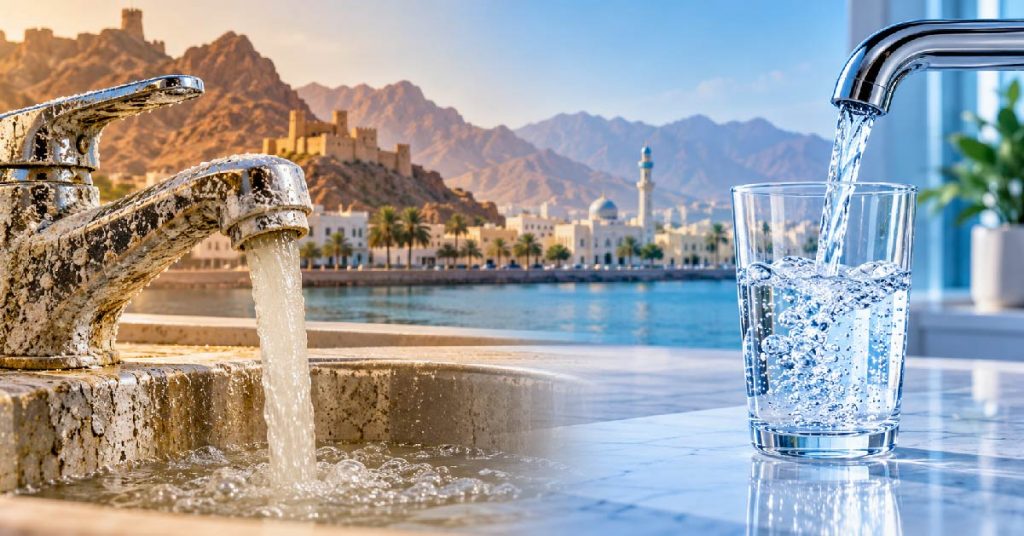
A white crust around a tap is easy to notice. So are cloudy marks on glassware, scale inside a kettle or the stubborn residue that refuses to disappear from bathroom fittings.
In Oman, these signs often lead to the same question: is the water safe to drink?
Not necessarily the right question.
Hard water in Oman is mainly a mineral issue. Drinking-water safety is much broader. Water can contain calcium and magnesium and still meet drinking-water requirements, while water that looks perfectly clear may still need to be assessed for microbiological or chemical contaminants.
Understanding that difference is useful for households, commercial facilities and industries because the treatment needed for hard water is not automatically the treatment needed to make water safe.
What Causes Hard Water in Oman?
Water is said to be hard, which means it contains minerals like calcium and magnesium in their soluble form. Water can test positive for hard minerals based on the kinds of materials through which it flows. Therefore, groundwater mineral content generally varies because of the geology of the area and dependence on the source of water.
Ion Exchange Oman marks the two main hardness-causing ions as calcium and magnesium and is aware that hardness is responsible for scale in the pipelines, boilers, heat exchangers, and domestic appliances. That is why in Oman water hardness is usually detected by people as a concern related to operation or maintenance rather than drinking water.
Hard Water and Safe Drinking Water Are Not the Same Thing
This is the distinction that matters most.
Hardness tells us about the concentration of certain dissolved minerals. Safe drinking water Oman requirements look at a much wider set of characteristics, including microbiological, chemical and physical parameters.
The current regulations governing drinking water in Oman are regulated by the Authority for Public Services Regulation, consisting of revised specifications and quality standards on unbottled drinking water as stated in Decision 2025/90.
The hardness of drinking water does not provide enough information. Even water with high mineral content can be compliant with relevant Oman standards for drinking water. On the other hand, drinking water with low hardness should not be assumed safe due to the presence of harmful microorganisms or chemical pollutants. This is why the properties such as appearance, taste and hardness may not be substitutes for proper testing of drinking water quality.
What Does Water Hardness Actually Tell You?
Total hardness is generally related to dissolved calcium and magnesium and is commonly expressed as calcium carbonate equivalent.
Oman Ministry of Health guidance for water quality identifies total hardness alongside parameters such as total dissolved solids, sulphate, sodium, nitrate and pH. Its guidance lists a desirable total-hardness level of up to 200 mg/L and a maximum of 500 mg/L for the applications covered by that document.
The useful takeaway is not simply the number.
Hardness becomes important because of what it does inside a system.
Where heated water is involved, mineral deposits may form faster. In boilers, hot-water systems and heat exchangers, this can interfere with heat transfer. In pipelines and fixtures, deposits can gradually restrict flow or create maintenance problems.
For a householder, the effect might mean scale on taps.
For a hotel, hospital or industrial plant, the same chemistry can turn into a much larger maintenance issue.
Hard Water vs Soft Water: Which Is Better?
The hard water vs soft water discussion often gets oversimplified.
Soft water is a type of water that has a low concentration of hardness causing minerals which consist solely of calcium and magnesium. This makes water much easier to work with in devices that tend to develop scale. This does not mean that all applications need water that is completely soft. Different applications such as a cooling circuit, a boiler feed system, and drinking water supply have their specific water quality requirements. The first step in designing a good treatment procedure is always looking at the purpose of use of water in the system rather than just considering the fact that softer is always better.
One of the methods used for softening water is ion exchange softening. In this process water containing hardness minerals flows through the resin bed where hardness minerals are exchanged for sodium ions. When the resin is saturated it needs to be regenerated.
In industrial systems lowering hardness of water is necessary for avoiding scale depositing and protecting process equipment.
In other applications aimed at obtaining drinking water, it is important to consider the overall chemistry of water rather than just the degree of hardness.
What Makes Drinking Water Safe in Oman?
Oman drinking water quality is assessed against more than taste, mineral level or clarity.
Drinking-water requirements address characteristics that can affect public health as well as acceptability. These include microbiological organisms and a range of chemical constituents.
Omani standards have historically required treated drinking water entering distribution systems to be free from E. coli and coliform bacteria in tested samples, alongside limits for various chemical parameters.
The country has since continued to update its regulatory framework, including the drinking-water quality regulation introduced in 2023 and newer specifications issued in 2025.
This is why testing matters.
The Oman government provides a water-sample testing service through the Ministry of Health to determine whether contaminants, bacteria or chemicals that could pose a risk are present.
A water-quality report can therefore answer a question that visual inspection cannot.
When Does Hard Water Need Treatment?
Hardness treatment usually becomes worthwhile when mineral levels begin affecting the intended use of the water.
Repeated scaling is one clear signal. So is loss of efficiency in equipment where water is heated.
In fact, its worth mentioning on no account must industrial users let their guard down, due to the fact any build-up of scale formation even on a small scale could be important when it comes to boilers, heat exchangers, production lines and even cooling systems. In many cases the cost of treatment is notably lower than of dealing with already formed deposits.
The option that suits a particular case will depend on the source water and the quality that is needed.
For instance, softening may be enough in cases the main problem is calcium or magnesium. However, reverse osmosis will be a better choice when it necessary to reach a wider objective related to dissolved solids content reduction.
A combination of pretreatment, membrane treatment and polishing will be necessary in some cases.
Why Water Testing Should Come Before Treatment
Consider two properties with similar scale problems.
The first receives groundwater with high hardness but otherwise acceptable chemistry. A properly designed softener may address the main problem.
The second has hardness plus elevated dissolved salts. Installing the same softener may remove calcium and magnesium while leaving the wider dissolved-solids issue largely unchanged.
The visible symptom looked the same. The treatment requirement was not.
That is why water treatment should begin with a representative analysis covering the parameters relevant to the source and application.
It sounds obvious, yet many inefficient treatment systems begin with equipment selection before the water itself has been properly understood.
How Ion Exchange Supports Water Treatment in Oman
Ion Exchange & Company LLC provides water and wastewater treatment products, engineering solutions and services across Oman for industries, institutions and communities. Its Oman operations cover sectors including oil and gas, steel and beverages, alongside broader water-treatment requirements.
Ion Exchange provides ion-exchange resins and softening systems for removing calcium and magnesium in applications requiring hardness treatment. In addition to these solutions, Ion Exchange also has a full range of membrane technologies for cases when hardness treatment may not be sufficient.
Such a capability is important, as water hardness in Oman cannot be viewed independently of the other parameters.
The total dissolved solids of water source, as well as other components of water chemistry, treatment capacity, type of water use, and conditions of use affect the type of solution needed.
Appropriate internal links can lead the reader to descriptive pages on Water Treatment Solutions, INDION Resins, Water Softening Systems, Reverse Osmosis Systems, and Operations & Maintenance Services.
Final Thoughts
Hard water is not another term for unsafe water.
Hard water in Oman mainly reflects the presence of minerals such as calcium and magnesium. Safe drinking water, on the other hand, has to satisfy a wider set of microbiological, chemical and quality requirements.
For households, hardness may be mostly a scale and maintenance concern. For commercial and industrial users, the same issue can affect equipment efficiency, heat transfer and operating costs.
The right decision starts with knowing what is actually in the water.
If hardness, scaling or inconsistent water quality is creating problems in your facility, connect with Ion Exchange experts to assess your source water and identify a treatment approach suited to the application.
FAQs
Is hard water in Oman safe to drink?
Hardness alone does not determine whether water is safe to drink. Calcium and magnesium cause hardness, but drinking-water safety must be assessed against microbiological and chemical quality requirements.
What causes water hardness in Oman?
Water hardness in Oman is primarily caused by dissolved calcium and magnesium. These minerals can naturally enter groundwater as water moves through mineral-bearing soil and rock.
What is the difference between hard water and soft water?
Hard water contains higher levels of calcium and magnesium. Soft water contains much lower levels of these hardness-forming minerals, usually naturally or after treatment.
How can I check Oman drinking water quality?
Laboratory testing is the reliable approach. Water can be tested for parameters such as hardness, pH, dissolved solids, microbiological quality and relevant chemical constituents depending on the source and intended use.
How is hard water treated?
Ion exchange softening is commonly used to remove calcium and magnesium. Reverse osmosis may be considered where broader dissolved-salt removal is required. The right method depends on the complete water analysis and the required treated-water quality.