

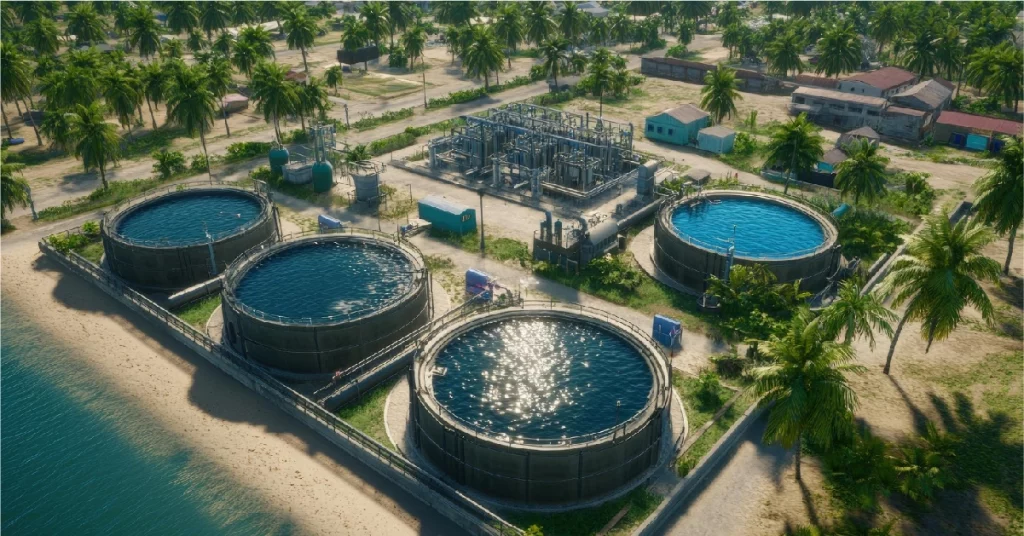
Industrial facilities need reliable water for production, utilities, cooling, boilers, and other processes. At the same time, the wastewater generated from these operations must be treated and managed according to applicable environmental requirements.
This makes industrial water treatment in Oman an important part of both operational efficiency and environmental compliance.
An effective treatment system does more than remove contaminants. It must be designed around the characteristics of the incoming water or effluent, the required treated-water quality, applicable discharge or reuse conditions, and the facility’s operating requirements.
Why Industrial Water Treatment Matters in Oman?
Industrial wastewater can contain:
- Suspended solids
- Organic matter
- Oils and grease
- Chemicals
- Dissolved salts
- Heavy metals
- Other process-specific contaminants
If inadequately treated, these contaminants can affect receiving water bodies, industrial operations, and the ability of a facility to meet its environmental obligations.
Oman’s Environment Authority provides a specific licensing process for the discharge or reuse of treated wastewater. The current requirements include an environmental permit, recent water-sample analysis from an approved laboratory, and compliance with the applicable wastewater reuse and discharge regulations.
What Are Oman’s Wastewater Compliance Requirements?
Industrial facilities managing treated wastewater in Oman need to consider the country’s environmental legislation and the conditions attached to their discharge or reuse licence.
The Environment Authority identifies the following regulatory framework for treated wastewater discharge and reuse:
- Royal Decree No. 114/2001 on the Environmental Protection and Pollution Control Law
- Royal Decree No. 115/2001 on the Protection of Drinking Water Sources from Pollution
- Ministerial Decision No. 145/93 and its amendments concerning wastewater reuse and discharge
- Ministerial Decision No. 55/2002
- Ministerial Decision No. 12/2017
- Technical requirements specified by the Environment Authority
This means compliance should be considered during treatment-system design rather than only after the plant has been commissioned.
How Industrial Wastewater Treatment Supports Compliance?
A properly designed industrial wastewater treatment system in Oman can combine several treatment stages depending on the type of effluent.
-
Preliminary Treatment
Screening and other physical processes remove larger solids and debris from wastewater.
-
Primary Treatment
Sedimentation and related processes reduce suspended solids and the initial pollutant load.
-
Chemical Treatment
Neutralisation, coagulation, and flocculation can help manage pH, suspended solids, oils, metals, colour, and other contaminants.
-
Biological Treatment
Biological processes use microorganisms to reduce biodegradable organic matter such as BOD and COD.
Technologies may include:
- Activated sludge
- MBBR
- SBR
- MBR
-
Advanced Treatment
Where higher-quality treated water is required, additional processes such as filtration, ultrafiltration, nanofiltration, reverse osmosis, or disinfection may be incorporated.
The appropriate combination depends on wastewater characteristics and the required final water quality.
How Water Treatment Systems in Oman Can Improve Compliance?
-
Consistent Treated-Water Quality
Treatment systems should be designed to handle variations in wastewater flow and contaminant concentration while maintaining the required output quality.
-
Effective Contaminant Removal
Different contaminants require different treatment mechanisms. Combining physical, chemical, biological, and membrane processes can provide more effective treatment than relying on a single process.
-
Regular Water Quality Monitoring
Monitoring treated-water quality helps operators identify changes in plant performance and take corrective action when required.
Oman’s current treated-wastewater discharge licensing process requires a recent water-sample analysis report issued by an approved laboratory.
-
Appropriate Discharge or Reuse Management
Compliance does not only concern discharge. Oman also regulates the reuse of treated wastewater, meaning facilities considering reuse need to ensure that the treatment system and final water quality are appropriate for the intended application.
Water Recycling and Reuse in Industrial Facilities
Water treatment can also support industries looking to reduce freshwater consumption.
A typical recycling approach can be:
Industrial wastewater → Treatment → Advanced purification → Recovered water → Reuse
Depending on the required quality, treated water may potentially be reused for:
- Cooling
- Irrigation
- Cleaning
- Utilities
- Selected industrial processes
Where higher-quality reuse is required, membrane technologies such as UF and RO can be incorporated.
This approach allows compliance and water efficiency to be considered together rather than treating wastewater only as a disposal requirement.
Technologies Used for Industrial Water Treatment
-
MBBR
Moving Bed Biofilm Reactor technology supports biological treatment using attached-growth media and can be considered for industrial wastewater applications.
-
MBR
Membrane Bioreactor technology combines biological treatment with membrane filtration to produce high-quality treated effluent.
Ion Exchange’s Oman performance data shows that MBR technology and industrial wastewater treatment are already established areas of local search visibility.
-
Reverse Osmosis
RO provides advanced removal of dissolved salts and other contaminants and can be used for high-quality water production or wastewater reuse.
-
Ion Exchange
Ion exchange resins can be used for applications such as softening, demineralisation, and selective removal of dissolved ionic contaminants.
-
ZLD
Where appropriate, Zero Liquid Discharge systems can combine RO, evaporation, and crystallisation to recover water and minimise liquid discharge.
Ion Exchange already has Oman-focused content around ZLD solutions, wastewater treatment, MBR, demineralised water, and filtration, making integrated treatment and water recovery relevant areas for the local market.
How to Choose the Right Industrial Water Treatment System in Oman?
Selecting a water treatment system in Oman should begin with the facility’s actual water and wastewater characteristics.
-
Analyse the Feed Water or Effluent
Important parameters can include:
- Flow rate
- pH
- TSS
- BOD
- COD
- TDS
- Hardness
- Oils and grease
- Specific chemicals or contaminants
-
Understand the Required Output Quality
The treatment objective may be:
- Industrial process water
- Boiler feed water
- Cooling water
- Treated effluent for discharge
- Recycled water
- High-purity water
The treatment process should be designed around the required final quality.
-
Consider Regulatory Requirements
The facility should identify the applicable discharge or reuse requirements and incorporate them into the treatment-system design.
-
Plan for Monitoring
Sampling, laboratory analysis, process monitoring, and documentation should form part of the overall compliance strategy.
-
Evaluate Water Reuse Opportunities
Where suitable, recycling treated wastewater can reduce freshwater demand while supporting broader sustainability goals.
Ion Exchange Industrial Water Treatment Solutions in Oman
Ion Exchange provides integrated industrial water treatment and wastewater-treatment solutions covering water purification, industrial effluent treatment, membrane systems, ion exchange, recycling, and advanced treatment.
Its capabilities include:
- Raw water treatment
- Industrial wastewater treatment
- MBR
- MBBR
- Filtration
- Reverse osmosis
- Demineralisation
- Ion exchange
- Water recycling
- ZLD solutions
Ion Exchange’s Oman-focused portfolio already includes industrial wastewater treatment, MBR technology, demineralised-water production, multimedia filtration, sludge dewatering, sewage treatment, and ZLD solutions.
This breadth allows treatment systems to be configured around the source-water characteristics, wastewater composition, required treated-water quality, and intended reuse or discharge route.
Why Regulatory Compliance Should Be Built Into Plant Design?
Waiting until the final stage of a project to evaluate compliance can create treatment gaps, additional modifications, or operational challenges.
A better approach is to consider compliance from the beginning:
Water analysis → Process design → Technology selection → Treatment → Monitoring → Laboratory testing → Discharge or reuse
This approach helps ensure that treatment performance and regulatory requirements are considered together.
For treated wastewater discharge or reuse in Oman, the Environment Authority’s current process requires the relevant licence and supporting documentation, including an environmental permit and recent laboratory analysis.
Conclusion
Effective industrial water treatment in Oman requires more than selecting a treatment technology. Industries need systems designed around their wastewater characteristics, required treated-water quality, monitoring requirements, and applicable environmental regulations.
By combining appropriate physical, chemical, biological, membrane, and advanced treatment processes, industries can improve water quality while supporting discharge compliance and opportunities for water reuse.
Ion Exchange provides integrated water and wastewater treatment capabilities for industrial applications, including MBR, filtration, demineralisation, RO, recycling, and ZLD solutions.
Connect with Ion Exchange experts for industrial water treatment, effluent treatment, water recycling, and compliance-focused treatment solutions in Oman.
FAQs
-
What regulations govern industrial wastewater discharge in Oman?
Oman regulates treated wastewater discharge and reuse through Royal Decrees 114/2001 and 115/2001 and Ministerial Decisions 145/93, 55/2002, and 12/2017, along with technical requirements specified by the Environment Authority.
-
Is a licence required to discharge or reuse treated wastewater in Oman?
Yes. The Environment Authority provides a licence for the discharge or reuse of treated wastewater and requires an environmental permit along with other supporting documentation.
-
What technologies are used for industrial wastewater treatment in Oman?
Depending on the wastewater characteristics, treatment can include chemical treatment, biological processes such as MBBR and MBR, filtration, RO, ion exchange, and ZLD.
-
Can treated industrial wastewater be reused in Oman?
Yes. Oman has a specific regulatory process covering the reuse of treated wastewater. The treatment level must be appropriate for the intended reuse application and comply with the applicable requirements.
-
How can industries maintain water quality compliance?
Industries should characterise their wastewater, design treatment around the required output quality, monitor plant performance, conduct required laboratory analysis, maintain the necessary environmental permits and licences, and comply with the applicable discharge or reuse conditions.