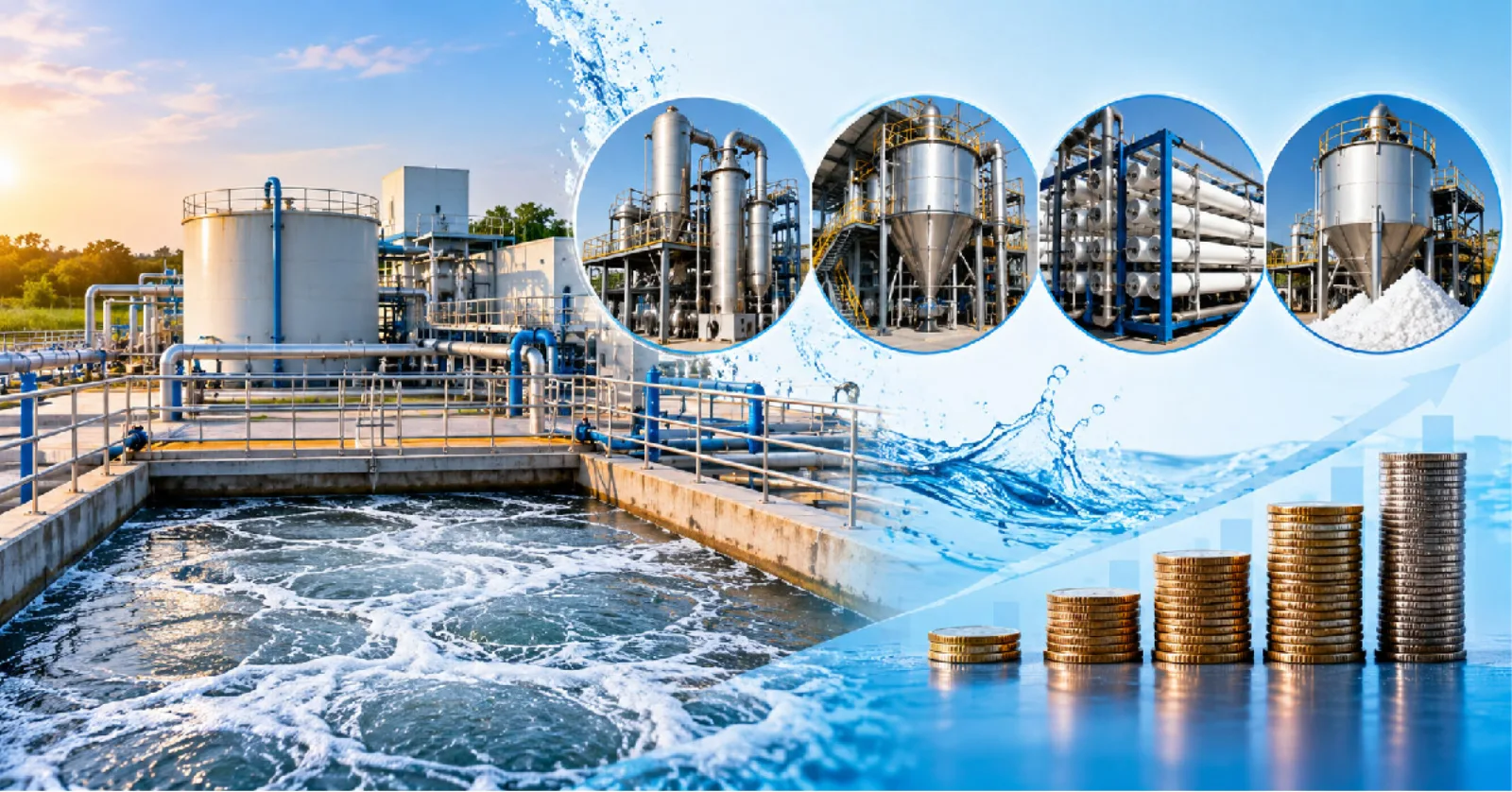
An industrial plant can recover most of its wastewater and still be left with a difficult problem: a relatively small quantity of highly concentrated reject. What happens to that remaining liquid? Sending it back through the same treatment process may not work, while disposal can be expensive or restricted. Ion Exchange addresses this challenge through integrated zero liquid discharge solutions that combine membrane treatment, evaporation and solids recovery. The objective is to recover usable water while managing the salts and other contaminants left behind.
But ZLD is not one machine. It is a combination of processes, each handling a different stage of wastewater concentration. Understanding how these technologies work together helps industries make better decisions about investment, energy consumption and long-term plant operation.
What Is Zero Liquid Discharge and How Does It Work?
Zero Liquid Discharge (ZLD) is an approach to wastewater management in which liquid effluent is treated and recovered for reuse, leaving concentrated residues or solids for appropriate handling.
A typical ZLD system begins with wastewater pretreatment. This may involve chemical treatment, biological processes, filtration or a combination of technologies, depending on the contaminants present.
Reverse osmosis can then recover a significant portion of the water. The remaining concentrate may be directed to thermal evaporation, followed by crystallisation or drying.
The exact arrangement varies.
Wastewater with high dissolved salts may require a different treatment route from effluent containing high organic loads. Some streams may even need to bypass conventional RO and move directly to specialised concentration processes.
That is why successful ZLD design begins with wastewater characterisation rather than equipment selection.
Reverse Osmosis: Recovering Water Before Thermal Treatment
Reverse osmosis (RO) is often an important part of an integrated ZLD process.
Pressure-driven membranes separate much of the dissolved salt content from water, producing permeate that may be suitable for industrial reuse after any necessary polishing.
The rejected salts remain in a smaller volume of concentrate.
This volume reduction matters because thermal evaporation generally requires considerably more energy than membrane separation.
Consider a plant processing 100 cubic metres of suitably pretreated wastewater. If RO achieves 75% recovery, approximately 75 cubic metres become permeate, leaving 25 cubic metres for further concentration.
That is an illustrative calculation, not a recovery guarantee.
Actual recovery depends on feedwater salinity, scaling tendency, membrane design and operating conditions.
Pushing RO recovery beyond the safe operating range can create scaling and fouling problems. The aim is to recover as much water as practical without making the downstream system less reliable.
MEE Evaporator: Concentrating High-TDS Wastewater
When wastewater is no longer possible to process via the usual membrane treatment, its evaporation calls for the use of thermal techniques.
A Multi-Effect Evaporator works by heating wastewater until some of it evaporates.
While a Single Effect Evaporator only uses one stage or effect, an MEE utilizes several stages to make use of value-added heat from one stage to the next.
Stages of MEE allow for vapor recovery that can be condensed back into treated water, as well as residual wastewater becoming more concentrated.
MEE is recognized as suitable for high-TDS effluents, RO reject and other high-volume flow process waters.
Heat exchange efficiency will depend on wastewater chemistry. Scaling salts and organic matter, as well as viscosity changes might reduce heat exchange efficiency and require additional cleaning.
Choosing an MEE for wastewater treatment doesn’t only involve estimating some evaporation capacity. The selection of MEE includes considerations of materials used, temperatures used in the process, energy available, and some concentrate properties.
ATFD: Handling the Concentrate Left Behind
A significant amount of water can be retrieved using an evaporator, however the resultant concentrate poses trouble.
This is the reason that ATFD, or Agitated Thin Film Dryer comes into play.
The machine allows the concentrated slurry to be applied as a thin film to the hot surface. The stirring of the material helps to move it while the moisture continues to evaporate.
The outcome is a dry material that can be collected for further processing.
It should be noted that ATFD accounts for the drying of difficult streams that solidify, and become viscous.
Nevertheless, the composition of the dried material will be contingent upon the wastewater used.
Thus, rather complicated substances that contain mixed salts and toxic impurities will require disposal at licensed locations.
The mere fact of an ATFD operation does not guarantee that water can be reused or sold again.
Nature of an ATFD is the moisture reduction and making the difficult concentrate into manageable solid.
Crystallisers: Separating Salts from Concentrated Brine
Crystallisers are another important part of certain ZLD arrangements.
Rather than simply drying a concentrated mixture, crystallisation promotes the formation and growth of solid crystals from dissolved salts.
As water is removed and the solution becomes supersaturated, salts begin to crystallise under controlled conditions.
The crystals can then be separated from the remaining liquid, often called mother liquor.
Different crystalliser designs are available, including forced-circulation arrangements suited to high-salinity applications.
The choice depends on salt composition, crystal characteristics, scaling behaviour and whether selective salt recovery is technically worthwhile.
In some industrial applications, separated salts may have potential value. In others, the output is a mixed residue that requires responsible disposal.
Crystallisers and ATFDs are not necessarily interchangeable. A crystalliser focuses on controlled crystal formation and separation, while an ATFD is commonly used to dry concentrated slurry or residual liquor.
How MEE, ATFD, RO and Crystallisers Work Together
The relationship between these zero liquid discharge technologies becomes easier to understand when following the wastewater through a treatment train.
After suitable pretreatment, RO recovers reusable water and concentrates the remaining dissolved salts.
The RO reject may then enter an MEE, where further water is evaporated and recovered as condensate.
Depending on the process design, the concentrated brine may move to a crystalliser for salt separation or an ATFD for final drying.
A facility evaluating MEE ATFD RO crystallizer in ZLD system configurations should remember that not every project needs all four technologies.
For instance, certain high-salinity streams may be better suited to direct thermal treatment. Other applications may benefit from additional membrane concentration before evaporation.
The treatment sequence should reflect the wastewater rather than follow a standard diagram.
Why Energy Consumption Matters in ZLD Design
One of the largest operating expenses in many ZLD installations is energy.
RO uses electrical energy to drive membrane separation. MEE systems require thermal energy, usually in the form of steam. ATFDs and crystallisers can add further heating, mechanical and utility requirements.
This is why reducing the volume reaching thermal treatment can improve project economics.
However, membrane recovery cannot be increased without considering scaling and operating limits.
Alternative thermal arrangements, including Mechanical Vapour Recompression (MVR), may also be evaluated where appropriate.
The choice depends on steam availability, electricity costs, wastewater composition and operating hours.
A technically successful ZLD plant should not become unnecessarily expensive to operate.
Common Problems Industries Face With ZLD Systems
Many operating difficulties begin with incorrect assumptions about wastewater quality.
If feedwater analysis misses high silica, hardness or organic contamination, membranes and evaporators may require more frequent cleaning than expected.
Another problem is inadequate segregation.
Combining high-salinity and relatively low-salinity wastewater can increase the volume requiring expensive treatment.
Equipment selection can also create difficulties. An evaporator designed without sufficient attention to scaling or viscosity may struggle as concentration increases.
These issues influence both operating expenses and plant availability.
Before selecting equipment, industries should examine wastewater composition, flow variations, potential recovery, residue characteristics and the utilities available at the site.
A complete water and salt balance is particularly important.
How Ion Exchange Supports Integrated ZLD Projects
Ion Exchange provides water and wastewater treatment solutions covering industrial effluent treatment, membrane separation, brine concentration and thermal evaporation.
Its ZLD portfolio includes advanced membrane systems, Multi-Effect Evaporators and other technologies used to recover water from concentrated wastewater streams.
The company also offers specialised solutions such as membrane brine concentration, helping reduce the volume that must undergo energy-intensive thermal treatment in suitable applications.
This integrated approach allows different treatment technologies to be evaluated as parts of one process.
For a textile facility, the challenge may involve colour, dissolved salts and water reuse. A chemical manufacturing unit may have more complex effluent characteristics. Another industry may need to manage high-TDS reject from an existing RO installation.
Ion Exchange can assess these requirements and develop a treatment arrangement based on wastewater characteristics, recovery objectives and operating economics.
Choose the Right Technology Combination
Achieving zero liquid discharge is not simply about installing an evaporator or drying the remaining wastewater.
It requires careful coordination between pretreatment, membrane recovery, thermal concentration and final solids handling.
RO can recover water efficiently within its operating limits. MEE reduces the volume of concentrated wastewater. Crystallisers separate salts, while ATFD systems can help dry difficult residual streams.
The right combination depends on what is present in the wastewater and what the facility needs to recover.
Planning a new ZLD facility or upgrading an existing system? Connect with Ion Exchange to evaluate your wastewater characteristics and explore integrated treatment, recovery and concentration technologies suited to your operating requirements.
Frequently Asked Questions
1. What is a zero liquid discharge system?
A ZLD system treats wastewater to recover usable water while converting the remaining contaminants into concentrated residues or solids, eliminating routine liquid effluent discharge.
2. What is the role of an MEE evaporator in ZLD?
An MEE evaporator concentrates high-TDS wastewater by evaporating water across multiple effects. Recovered condensate may be treated further and reused.
3. What is the difference between ATFD and a crystalliser?
An ATFD is primarily used to dry concentrated liquid or slurry into a low-moisture residue. A crystalliser is designed to promote controlled salt-crystal formation and separation.
4. Why is RO used before evaporation in ZLD?
Reverse osmosis can recover a substantial portion of the water before thermal concentration. This reduces the volume entering energy-intensive evaporation equipment, provided membrane treatment is suitable for the wastewater.
5. Which zero liquid discharge technologies are best for industrial wastewater?
The appropriate combination depends on wastewater salinity, organic load, scaling potential, recovery requirements and available utilities. Common options include RO, MEE, ATFD, crystallisers and specialised brine-concentration technologies.